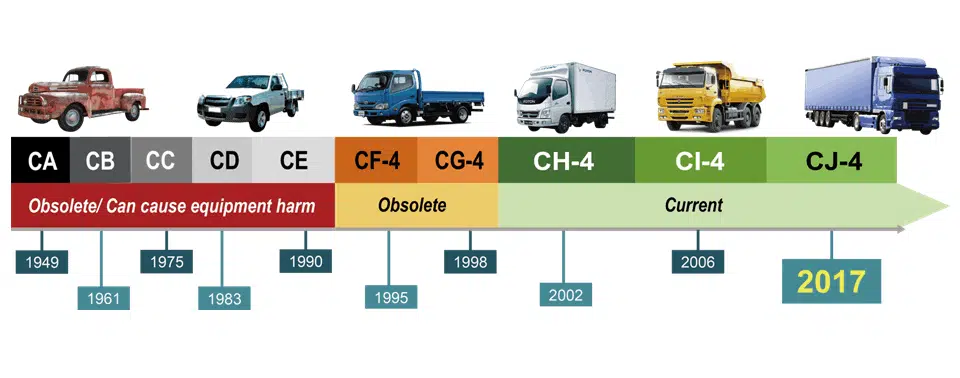
Choosing the right oil for your truck is crucial for its smooth operation. Discover information about truck oil with AutoX Furion to select the most suitable type for your vehicle.To assess the quality of engine oil for heavy-duty trucks and semi-trailers, two standards must be considered: the oil grade according to the API (American Petroleum Institute) standard and the viscosity grade according to the SAE (Society of Automotive Engineers) standard. API grades for gasoline engines are indicated with the letter “S,” for example: SA, SB, SC, SE, SF, SG, … up to SN (highest grade). API grades for diesel engines are indicated with the letter “C,” for example: CA, CB, CC, CD, …
This index is often referred to as oil grade or rating. The higher the rating, the more advanced the additives, which meet the demanding requirements of modern vehicle components.
Engine oil can have more than one rating, meaning it can be used in both gasoline and diesel engines. Vehicle owners should check the API designation to determine the preferred quality grade.
SAE stands for Society of Automotive Engineers, and viscosity is measured in two ways: monograde oil and multigrade oil.
Single grade oil
Designated as SAE 40, SAE 50: Viscosity decreases rapidly with temperature. This type of oil is perfectly suitable for use in the Vietnamese environment. However, when the engine is cold, the oil will be slightly thicker and not pumped effectively to the engine parts; the heat dissipation capacity of single-grade oil is also very poor. This type of oil is commonly used for 2-stroke engines, lawnmowers, agricultural and industrial machinery, or for users to mix with special additives.
Multi-grade oil
Designated as SAE 20w-40, SAE 15w-40: The viscosity of this oil is more stable with temperature compared to single-grade oil. Furthermore, the oil’s viscosity remains consistent even at low temperatures, thus improving lubrication when the engine is “cold”
autox furion
To assess the quality of engine oil for heavy-duty trucks and semi-trailers, two standards must be considered: the oil grade according to the API (American Petroleum Institute) standard and the viscosity grade according to the SAE (Society of Automotive Engineers) standard. API grades for gasoline engines are indicated with the letter “S,” for example: SA, SB, SC, SE, SF, SG, … up to SN (highest grade). API grades for diesel engines are indicated with the letter “C,” for example: CA, CB, CC, CD, …
This index is often referred to as oil grade or rating. The higher the rating, the more advanced the additives, which meet the demanding requirements of modern vehicle components.
Engine oil can have more than one rating, meaning it can be used in both gasoline and diesel engines. Vehicle owners should check the API designation to determine the preferred quality grade.
SAE stands for Society of Automotive Engineers, and viscosity is measured in two ways: single-grade oil and multi-grade oil.
- Single-grade oil
- Designated as SAE 40, SAE 50: Viscosity decreases rapidly with temperature. This type of oil is perfectly suitable for use in the Vietnamese environment. However, when the engine is cold, the oil will be slightly thicker and not pumped effectively to the engine parts; the heat dissipation capacity of single-grade oil is also very poor. This type of oil is commonly used for 2-stroke engines, lawnmowers, agricultural and industrial machinery, or for users to mix with special additives.
- Multi-grade oil
- Designated as SAE 20w-40, SAE 15w-40: The viscosity of this oil is more stable with temperature compared to single-grade oil. Furthermore, the oil’s viscosity remains consistent even at low temperatures, thus improving lubrication when the engine is “cold”…
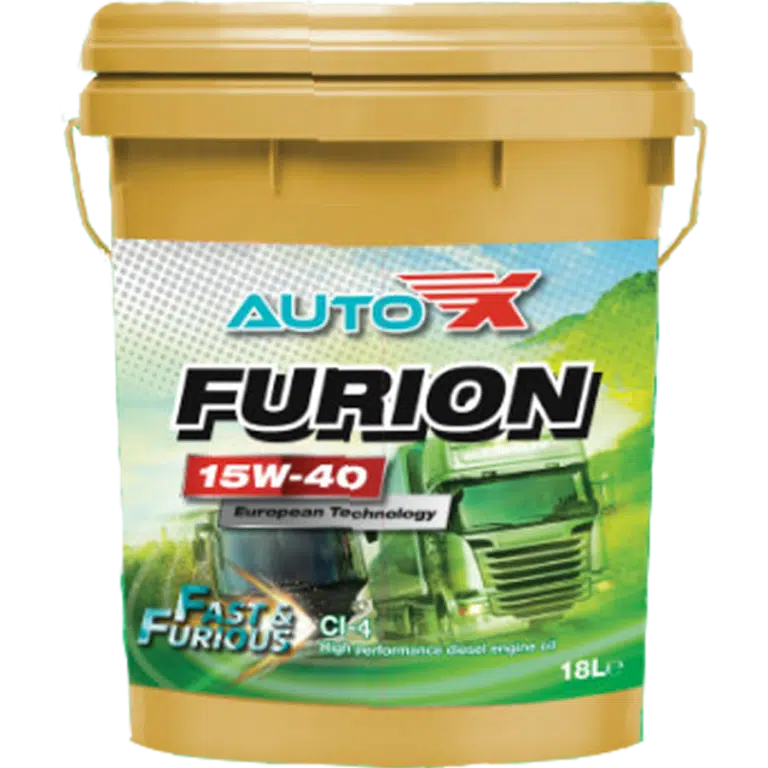
For example, AutoX Furion SAE 15W40 has more stable viscosity with temperature compared to single-grade oils.
autox furion
Viscosity plays a crucial role in the properties of engine oil. According to the SAE viscosity rating system, oils with the letter “W” are multi-grade, suitable for all seasons. The SAE classification system is quite complex, involving many different concepts. However, the main factors can be identified. For multi-grade oils, the letters SAE are followed by a prefix such as 5W, 10W, 15W, or 20W.
The numbers before the “W” (also known as the initial rating) indicate the temperature range at which the oil has sufficient viscosity to start the vehicle in cold conditions. To determine the starting temperature based on this rating, simply subtract the number from 30, but in negative temperatures. For example, 10W oil will start well at -20°C, and 15W oil will start well at -15°C.
Engine oils in cold climates are typically 5W, 10W, or 15W, but most products in Vietnam are only 10W, 15W, or 20W. While this isn’t crucial for starting in Vietnam, where the weather isn’t usually very cold, manufacturers add additives to meet cold-start requirements, so lower viscosity oils are more expensive. 10W, 15W, and 20W oils are mid-priced and are therefore imported or produced in Vietnam by many lubricant companies.
The “W” in multi-grade oils may be followed by 40, 50, or 60. Generally, the higher the number, the higher the viscosity, and vice versa.
This indicates the equivalent viscosity at operating temperature. For example, with 10W40 oil, at normal temperatures it is quite thin, equivalent to SAE 10 oil, but at high temperatures in contact with machine parts, the oil will form a film with a viscosity equivalent to SAE 40 oil.
AutoX truck engine oil is manufactured using advanced European technology and meets Swiss quality standards, ensuring optimal performance for your truck fleet.